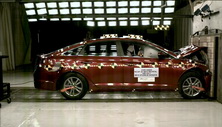
Open safety recalls, the components owners report failing most often, crash-test results and running costs for the 2017 Hyundai Sonata, assembled from NHTSA and EPA records.
One specific car
Checking one Hyundai Sonata?
Everything on this page applies to the model as a whole. Run its VIN to decode that exact car, its engine, trim, assembly plant and factory equipment, alongside these records.
Recalls and complaints are filed against a specific model year, so figures differ from one year to the next even within a single generation. See every Hyundai Sonata year.
NHTSA Recalls
Safety recalls
3 open
NHTSA lists 3 recalls for this make, model and year. Recalls apply to the model, so some may already be fixed on this specific car. A dealer can confirm from the VIN.
AIR BAGS:FRONTAL:DRIVER SIDE:INFLATOR MODULE30/12/2016
Issue: Hyundai Motor Company (Hyundai) is recalling certain model year 2017 Hyundai Elantra vehicles manufactured April 15, 2016, to September 13, 2016, and Sonata vehicles manufactured May 27, 2016 to September 16, 2016. In these vehicles, the end seal for the driver's frontal air bag inflator may not have been properly installed, possibly resulting in reduced inflation of the frontal air bag in the event of a crash.
Risk: In the event of a crash, an air bag that does not inflate fully increases the risk of injury.
Remedy: Hyundai will notify owners, and dealers will replace the driver's frontal air bag module, free of charge. The recall began February 13, 2017. Owners may contact Hyundai customer service at 1-855-371-9460. Hyundai's number for this recall is 156.
Campaign 16V956000
EXTERIOR LIGHTING:TURN SIGNAL24/09/2021
Issue: Hyundai Motor America (Hyundai) is recalling certain 2015-2017 Sonata, 2016-2017 Sonata Hybrid, and Sonata Plug-In Hybrid vehicles. The Smart Junction Box (SJB) software logic may not properly interpret the signals received from the multifunction switch, which could cause the turn signal to activate in the opposite direction of what the driver intended.
Risk: A turn signal that activates in the opposite direction of what was intended by the driver increases the risk of a crash.
Remedy: Dealers will update the SJB software, free of charge. Owner notification letters were mailed November 19, 2021. Owners may contact Hyundai customer service at 1-855-371-9460. Hyundai's number for this recall is 210.
Campaign 21V749000
LATCHES/LOCKS/LINKAGES:TRUNK LID:LATCH06/08/2021
Issue: Hyundai Motor America (Hyundai) is recalling certain 2017-2018 Sonata, 2016-2018 Sonata Hybrid, 2018-2020 Accent, and 2016-2017 Azera vehicles. The trunk latch may become damaged, preventing the opening of the trunk from the inside. As such, these vehicles fail to comply with the requirements of Federal Motor Vehicle Safety Standard number 401, "Internal Trunk Release."
Risk: A person inside the trunk compartment may become trapped, increasing their risk of injury.
Remedy: Dealers will replace the trunk latch base, free of charge. Owner notification letters were mailed December 4, 2021. Owners may contact Hyundai customer service at 1-855-371-9460. Hyundai's number for this recall is 208.
I was driving down the road when my sunroof glass completely ripped away from the top and flew off. The glass is gone but the frame is still there but bent. I took it to a auto glass repair shop that stated "sunroof glass separated from urethane, came off and bent frame." I am dropping off at Hyundai dealership 9.17.26 to have them inspect. My insurance will not cover repairs. So I am hoping maybe this has happened to other people. There was a recall on sunroofs for the 2014-2016 Hyundai Sonata's NHTSA campaign 16V726000 A bonding issue with the front sunroof wind deflector anchor plate can cause the deflector to come loose and jam the glass panel when closing, or detach entirely while the car is moving.
ENGINE09/04/2026
The vehicle suffered a sudden, catastrophic internal mechanical engine failure out of nowhere without any warning lights or previous symptoms. An inspection of the engine cylinder revealed a physical hole blown through the top of the Cylinder 2 piston, causing immediate and complete loss of engine compression. This sudden structural failure caused the vehicle to completely lose all propulsion and stall unexpectedly while in operation, creating an immediate, severe safety hazard on the road.This vehicle features Hyundai's 2.4L Theta II Gasoline Direct Injection (GDI) engine, a family with a well-documented history of manufacturing defects, severe oil consumption, and catastrophic internal structural failures. Because this failure occurred instantly and without a progressive warning, it put occupants at risk of a severe rear-end collision or stranding in an unsafe traffic pattern. I am filing this safety report because the catastrophic destruction of the internal engine components presents a persistent and dangerous hazard to public safety.
ENGINE07/26/2026
We had a recall done, Campaign 92C, and every since then the car drives horrible. It's worse when cool, it sputters, and hesitates especially when excellerating. Even after warmed up it seems to slam in and out of gear at low speeds, even when foot is not on the gas. The drive is choppy. The dealership told us to drive it and let the transmission "learn" our driving patterns, but it has not resolved itself. Before campaign car ran smooth, now shuttering and sputtering.
STEERING,ELECTRICAL SYSTEM,SEATS07/25/2026
I was driving and all of a sudden the traction lights turned on and the sterring wheel is hard to turn. Almost go in a car accident. The windows just stopped working and the brakes light constantly keep getting burned out.
I am writing to report a direct violation of the Theta II Class Action Settlement terms by Hyundai Motor America. This morning , I emailed an Executive Case Manager explicitly explaining that my 2017 Sonata has an active P1326 code, has the 2019 KSDS update, and requires a mandatory diagnostic under NHTSA Recall 17V226 that cannot be denied due to a salvage title. Instead of replying to my facts, the Case Manager Kathy gave me a hard denial falsely framing my federal recall safety request as a "voluntary goodwill warranty" issue to justify her rejection. Please help me in getting authorization my car with Hyundai dealership in Plano Tx to run the bearing rod test and get it fixed.
UNKNOWN OR OTHER,ENGINE07/06/2026
My engine seemed to be consuming oil way to much I had to do a oil change at 61,000 recommend by tire plus but at 58,000 is when I had to change my oil I also noticed there is a buring smell and its also been leaking oil at times I went to get it checked out by a mechanic at tireplus but they also they are seeing that the oil consumption was not normal and they recommend a possible recall for it because it hazardous for how fast its consuming and the leaks
ENGINE06/30/2026
Driving home from work on [XXX] (not a safe location)when my car lost power and engine light began to flash. I pulled off to the side of road and called my dad. He came with a code reader and said there was a code P1326. He cleared the code and car drove normally again. 2 days later it began to run rough. I was told about the engine recall so I called Hyundai corporate and told them this same story. I was advised to take to dealership and have the “rod bearings inspected” and shouldn’t matter that my dad cleared the code. The dealership(Massey Hyundai MD) said it had a burnt valve and not part of warranty. But never checked rod bearings. When I called corporate. They said nothing they could do. INFORMATION REDACTED PURSUANT TO THE FREEDOM OF INFORMATION ACT (FOIA), 5 U.S.C. 552(B)(6)
ENGINE06/23/2026
High oil consumption, burning a quart of oil or more every 500 miles since bought used at Hyundai dealership.
POWER TRAIN,ELECTRICAL SYSTEM,ENGINE06/22/2026
My 2017 Hyundai Sonata SE, equipped with the Theta II 2.4L GDI engine, is experiencing severe powertrain failures including rhythmic metallic engine knocking, catastrophic oil consumption, and un-commanded surges/jumping in speed while driving. These symptoms manifested following an unauthorized engine replacement performed by Hyundai of El Cajon under Repair Order [XXX], where the dealer covertly outsourced my vehicle to a third-party shop (Legacy Motor Works) to install an unverified used salvage engine block rather than a certified factory assembly. This vehicle is a Class Vehicle under In re: Hyundai and Kia Engine Litigation (Case No. [XXX]), and the KSDS software update (Campaign 953) was successfully completed on my vehicle in 2019. The engine knock, surging, and oil consumption are consistent with the known connecting rod bearing failure defect described in NHTSA investigation PE17-007. The dealership is currently denying warranty coverage, citing a mileage limit that does not exist under my Lifetime Powertrain Warranty, and they are withholding physical documentation of the repair terms. The vehicle is also experiencing secondary safety failures, including a continuous airbag SRS warning light (two years) and electrical shorts caused by the salvage-yard alternator installation, which have destroyed 4 to 5 car batteries. This engine failure represents a significant safety hazard, as the vehicle periodically loses power and surges without driver input. I am requesting that NHTSA investigate this pattern of warranty denial, parts-sourcing fraud, and the safety risks posed by this substandard engine installation. INFORMATION REDACTED PURSUANT TO THE FREEDOM OF INFORMATION ACT (FOIA), 5 U.S.C. 552(B)(6)
STEERING,AIR BAGS06/11/2026
The RED light is lit on the dashboard for the airbag. Unable to use steering wheel electronic features which helps with and was designed for hands free controls. I am unable to cycle through the electronic features or engage the cruise control due to the steering wheel electronics are in-op. Please help and get a recall started. This is not on the consumer.
SUSPENSION,POWER TRAIN,ENGINE06/06/2026
[XXX] [XXX] [XXX]; [XXX] [XXX] [XXX] Date: XXX To: National Highway Traffic Safety Administration Office of Defects Investigation (ODI) Subject: Formal Safety Defect Complaint – 2017 Hyundai Sonata Theta II Engine Failure, Excessive Oil Consumption, Intake/Engine Component Failure and Safety Hazard Dear Sir or Madam: I am submitting this formal complaint and request for immediate investigation into the dangerous and ongoing mechanical failures involving my 2017 Hyundai Sonata equipped with the Theta II engine. I believe this vehicle contains a serious manufacturing and/or engineering defect that presents a substantial safety hazard to consumers. My vehicle has experienced a pattern of progressive mechanical failure beginning with abnormal and excessive oil consumption, which appears to be directly associated with malfunctioning engine airflow and intake-related components. Specifically, the lower engine airflow system and intake functionality appear defective, placing excessive strain on the intake manifold system and contributing to cascading engine failures. As a result of these failures, the vehicle has experienced: Severe and excessive oil burning/consumption Intake manifold malfunction and abnormal operating stress Suspected overheating and/or premature head gasket failure Ignition coil failure and electrical shorting/misfires Progressive engine deterioration rendering the vehicle unsafe and unreliable Increased risk of sudden engine shutdown, stalling, fire hazard, or catastrophic engine failure while operating The vehicle has become increasingly unreliable and inoperable due to these conditions. These failures raise significant concerns regarding public safety, especially given the known history of complaints and recalls associated with Hyundai Theta II engine defects. I am deeply concerned that this vehicle may reflect a broader pattern of defective manufacturing, insufficient quality control. INFORMATION REDACTED PURSUANT TO THE FREEDOM OF INFORMATION ACT (FOIA), 5 U.S.C. 552(B)(6)
Supplemental Information to Existing NHTSA Complaint involving a 2017 Hyundai Sonata Plug-in Hybrid (VIN: [XXX] ) While traveling at approximately 70 MPH on a heavily traveled highway, the vehicle suddenly and completely lost propulsion without warning. The vehicle rapidly decelerated in traffic, creating a significant safety hazard for my family and surrounding motorists and requiring emergency maneuvering to reach the shoulder. The vehicle was towed to an authorized Hyundai dealership, where diagnostic testing identified multiple high-voltage battery system fault codes: • P0B68 • P0B6D • P0B72 The dealership diagnosed a high-voltage battery system failure requiring battery replacement. The vehicle is currently non-drivable. During my research, I found multiple owner reports involving Hyundai Sonata Hybrid and Plug-in Hybrid vehicles experiencing loss of power, hybrid system failures, limp mode conditions, and propulsion-related incidents. I also learned that Hyundai previously issued Recall 18V166000 involving 2016–2018 Sonata Plug-in Hybrid vehicles due to battery management system and voltage protection device concerns that could result in loss of power while driving. Dealer says does appply for my car. Although my vehicle’s fault codes may differ from those addressed in the recall, both involve battery-related failures capable of affecting propulsion and creating a highway safety risk. My concern extends beyond my individual vehicle. A high-voltage battery or battery management system failure that can cause a complete loss of propulsion at highway speed without warning presents a potentially serious safety risk. I respectfully request that NHTSA evaluate whether similar incidents involving Hyundai Sonata Hybrid and Plug-in Hybrid vehicles indicate a broader safety concern warranting further review. I can provide dealership diagnostic reports, repair estimates, towing records, photos, and videos upon request. Thank you for your consideration, [XXX] INFORMATION REDACTED PURSUANT TO THE FREEDOM OF INFORMATION ACT (FOIA), 5 U.S.C. 552(B)(6)