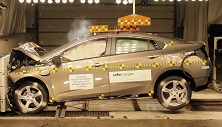
Open safety recalls, the components owners report failing most often, crash-test results and running costs for the 2018 Chevrolet Volt, assembled from NHTSA and EPA records.
One specific car
Checking one Chevrolet Volt?
Everything on this page applies to the model as a whole. Run its VIN to decode that exact car, its engine, trim, assembly plant and factory equipment, alongside these records.
Recalls and complaints are filed against a specific model year, so figures differ from one year to the next even within a single generation. See every Chevrolet Volt year.
EPA fueleconomy.gov
Fuel economy and running cost
42 mpg
43mpg
City
42mpg
Combined
42mpg
Highway
What drivers actually get4 owners
101.1 mpg average · 71–162 range · EPA says 42
Over 5 years this costs $6,750 less in fuel than an average new vehicle.
NHTSA lists 2 recalls for this make, model and year. Recalls apply to the model, so some may already be fixed on this specific car. A dealer can confirm from the VIN.
SERVICE BRAKES, HYDRAULIC:FOUNDATION COMPONENTS:DISC:CALIPER30/08/2018
Issue: General Motors LLC (GM) is recalling certain 2018-2019 Chevrolet Equinox, Impala, Cruze, Volt and Bolt EV vehicles, GMC Terrain vehicles, Buick Lacrosse and Regal vehicles, Cadillac XTS and XTS Professional vehicles and 2018 Chevrolet Malibu vehicles. The rear brake caliper pistons may have an insufficient coating causing gas pockets to form, potentially reducing rear brake performance.
Risk: A reduction of braking performance can increase the risk of a crash.
Remedy: GM will notify owners, and dealers will bleed the vehicle's brake system, free of charge. The recall began October 11, 2018. Owners may contact Buick customer service at 1-800-521-7300, Cadillac customer service at 1-800-458-8006, Chevrolet customer service at 1-800-222-1020, or GMC customer service at 1-800-462-8782. GM's number for this recall is 18279.
Campaign 18V576000
SEAT BELTS:REAR/OTHER26/09/2018
Issue: General Motors LLC (GM) is recalling certain 2018-2019 Cadillac CT6, Escalade ESV, Chevrolet Suburban, Volt, and GMC Yukon XL vehicles. Certain second-row or third-row rear seatbelts retractor assemblies may not automatically lock when the seatbelt is fully pulled out of the retractor, possibly preventing a child seat from being properly secured. As such, these vehicles fail to comply with the requirements of Federal Motor Vehicle Safety Standard (FMVSS) number 208, "Occupant Crash Protection."
Risk: If the child seat is not properly secured in the event of a crash, it can increase the risk of injury.
Remedy: GM will notify owners, and dealers will inspect the rear seatbelt retractors and replace them if necessary, free of charge. The recall began November 7, 2018. Owners may contact Cadillac customer service at 1-800-458-8006, Chevrolet customer service at 1-800-222-1020 or GMC customer service at 1-800-462-8782. GM's number for this recall is 18315.
UNKNOWN OR OTHER,ENGINE,FUEL/PROPULSION SYSTEM08/27/2026
I was driving back from [XXX] on XXX, when I received a "propulsion power limited" message on my dash with a check engine light. I pulled off to a nearby gas station and tried to scan the code to figure out what was going on when I then received the message "Engine unavailable" and the car shut off. I checked the fuse box and found that the F03 Fuse had blown. I replaced the fuse and attempted to start the car again. It began normally, but then after driving 10 feet, I received the "engine unavailable" message again with a check engine light and the car no longer had power and I had to coast into a parking spot. I checked the fuse again and found it was blown. If I had not stopped in the gas station, I would have been stranded on the side of the highway, or worse yet, I would have stalled out on the highway and potentially got hit. I had my car towed to a dealership who eventually completed their inspection of the car on XXX and determined that the EGR Valve had failed (the servo motor burned out and blew the F03 Fuse). This is a well known issue on the 2nd Generation of Volts and it is likely faulty servo motors in the EGR valves. The Dealership even included in its financial assistance request to Chevy on my behalf that the EGR valve failure is a known issue. When asked if there was any preventative maintenance suggested to prevent the EGR valve from failing, the service technician indicated that there wasn't anything that I did as the end user to cause the problem. INFORMATION REDACTED PURSUANT TO THE FREEDOM OF INFORMATION ACT (FOIA), 5 U.S.C. 552(B)(6)
POWER TRAIN,ELECTRICAL SYSTEM08/27/2026
The vehicle frequently fails to register that the transmission has been shifted into Park. When this happens the instrument cluster displays "Action Required / Shift to Park" and the power (STOP/START) button will not shut the vehicle off. The condition is intermittent. I can usually clear it only by shifting through the gear positions and back into Park repeatedly, sometimes many times, before the vehicle will power down. SAFETY RISK: Because the transmission control module does not confirm Park, I have no assurance the parking pawl is engaged when I leave the vehicle, creating a rollaway hazard. The vehicle also cannot be shut down, which leaves its systems energized and drains the 12-volt battery, risking being stranded. I now apply the parking brake at every stop as a precaution. WARNING MESSAGE: The "Action Required / Shift to Park" message first appeared within days of purchase. I bought the vehicle used on 07/29/2026 at 69,471 miles and reported the fault to the selling dealer on 08/10/2026, twelve days later. CONFIRMED BY DEALER: Yes. On 08/19/2026 the selling dealer's service center diagnosed the cause as "internal shifter microswitch failure" and recorded the correction as "Replaced Transmission shifter controller assembly and cleared codes" (repair order 1133072). The fault returned within approximately half a day. On 08/26/2026 the dealer opened a second order for the same concern, recording the same cause and the same correction and listing the same part, shifter assembly part number 13540961 (invoice 1133224). The vehicle is currently at that service center and the defect is not corrected. The condition is worsening — it occurs more often and takes more attempts to clear than when first reported. The vehicle is available for inspection. It has not been inspected by the manufacturer, by police, or by an insurance representative.
FUEL/PROPULSION SYSTEM08/17/2026
I was driving on an interstate in Seattle, and the car completely died. A check engine light went on. I had to roll into the shoulder and call for a tow to the dealership's service department. Here is what they found: ----60GCZ ENGINE REPAIR DIAG/ customer reports the ses lamp is on with reduced propulsion message displayed. Check and advise. 1. Tested vehicle and verified reduced propulsion power message and SES light. Scanned vehicle for codes and found multiple P0489, P0030, P0031, P0132, P0135, P0137, P0443, P0458, P0597, P0598, P06DA, P06DB, and P103C. Traced back to no power on circuit 5293. Traced back to blown 15-amp fuse 3 of under hood fuse block. Found bulletin #24-NA-080 stating this can be caused by a short in the EGR valve. Tested circuit 5293 and found short at the EGR valve. Advise EGR valve and cooler replacement then retest.---- We disconnected the EGR valve, which means we are driving only on gas, not electric. We cannot charge it anymore. The cost to replace the valve and cooler is over $4k because Chevrolet does not make the vehicle anymore or the EGR valve part apparently. This is a SIGNIFICANT safety hazard if the car is going to simply die suddenly. It is a miracle I did not get hit.
POWER TRAIN,UNKNOWN OR OTHER08/07/2026
What component or system failed? When the BCEM failed on my car, it led directly to the transmission failing as well as the PIM. I was driving normally then had a completely inoperable car with no warning. I was told to pay over $17k for repairs by the dealership because there is no recall on the transmission, but I see proof that this is a common issue among Volt users. There needs to be a recall and repair to keep the road safe. How was your safety or the safety of others put at risk? I was driving on a busy road to school when my car fully locked up, jerked like crazy, and became inoperable. If I had been somewhere like a freeway instead of in front of a school, I likely would have become badly injured when the wheels stopped even turning. The tow truck even had to use wood under my wheels to get it onto the tow truck. Has the problem been reproduced or confirmed by a dealer or independent service center? I took it to the dealership and worked only with them. They replaced the BCEM without charge but have left me with an inoperable vehicle because I am unwilling to pay twice the cost of the car to repair it. Has the vehicle or component been inspected by the manufacturer? Dealership. But also, as mentioned, this is clearly common and needs to be recalled. A 2018 car with 117k miles of gentle driving on a well maintained vehicle shouldn't be failing, and there shouldn't be so many Volts being sold for parts because their transmission failed. This is clearly a dangerous issue related to production and should have a recall. Were there any symptoms of the problem prior to the failure, and when did they first appear? I bought the car with just under 16k miles in 2021 and within 3 months I had symptoms, but the dealership couldn't figure them out, as they happened intermittently and only in heat, and the dealership always sent me away without repairs. The failure itself happened at 62°, but was foreshadowed by lesser versions of its demise.
While driving on a highway the car started to hesitate, a message appeared on the console "Propulsion power is reduced" and the engine light turn on. After driving some miles, a new message appeared: "Engine unavailable, service soon" and the car only ran on electric power, no motor engine. I had the same problem 3 year ago and the dealer identified the problem as a shorted EGR valve. This time I knew this shorted EGR valve burns the F3 fuse. I managed to get to a car part shop and bough several fuses (15 amp). After replacing the fuse 3 times I managed to get to the dealer. The repairs cost $3000+ (up from $1000+ 3 years ago). This problem is well documented on the GM service technical bulletin "21-NA-116" dated February, 2023. Three years ago I was in the middle of nowhere in South Texas and it took 6 hours to get a tow truck This time I was lucky enough to be close to to a town that the remain battery power was enough to get to the store where I bought the fuses. GM should recall this part and do a proper fix
The Vehicle had a the BECM fail at 64,000 miles. This is a known issue that GM still refuses to recall, and is refusing to warranty
FUEL/PROPULSION SYSTEM07/28/2026
I was investigating a thumping sound coming from the vehicle when going over bumps. I discovered that the left fuel tank strap had completely broke into two pieces and was no longer holding up the tank. The fuel tank straps are not readily viewed on the vehicle until you lower/remove the underbody aerodynamic material. It appears that the underbody aerodynamic material may have been contributory by retaining dirt and trapping moisture in contact with the tank straps. The failed tank strap parts are available for inspection. No other indication of the failed tank strap other than the minor noise and no other inspections have been performed on the failed component.
The Battery Energy Control Module (BECM) failed. Before repair, the check-engine light appeared intermittently, the vehicle sometimes had difficulty starting, and the indicated electric range could suddenly drop from about 30 miles to zero despite a charged high-voltage battery. When this occurred, the gasoline engine started unexpectedly. The air conditioning also intermittently blew warm air until the vehicle was restarted. These symptoms created a safety concern because propulsion mode and indicated range could change without warning, and the vehicle could fail to start in traffic or another unsafe location. An authorized Chevrolet dealer confirmed the problem. The dealer retrieved DTCs U2624 and U2629, performed circuit testing, and diagnosed an internal short in the BECM causing loss of communication with high-voltage battery modules. The dealer stated this failure caused the warning light, starting issue, sudden loss of indicated battery range, and air-conditioning symptoms. The BECM was replaced and programmed after removal of the high-voltage battery assembly. The warning light first appeared about one month before repair, with the other symptoms becoming more apparent in early July 2026. The vehicle had approximately 80,918 miles when inspected. The failed component was retained by the dealership as a core and is not available to me for inspection. To my knowledge, the vehicle was not separately inspected by police, insurance, or GM engineering personnel. My vehicle was excluded from GM Special Coverage N232432680 even though it is a 2018 Chevrolet Volt with the same confirmed BECM failure addressed by that program and NHTSA investigation PE23022. I paid $3,970.56 for the repair. I am filing this complaint because this defect can cause no-start, loss of indicated battery range, warning lights, unexpected propulsion changes, and potentially reduced propulsion, while some affected 2016–2018 vehicles appear excluded from the special coverage.
UNKNOWN OR OTHER07/06/2026
My 2018 Chevy Volt started making a creaking and clanking noise when driven at low speeds. Dealer diagnosed the problem as being the rear shocks and bushing. Replacing these did not fix the problem. Not sure if this is a safety issue or not.
The car suddenly lost power and produced error messages on the screen. I had to quickly change lanes to get out of traffic on the highway. My dealer diagnosed the issue as a BECM malfunction and quoted a repair cost of approximately $3500. However, due to my car originally being registered in California, this failure is not covered under GM Special Coverage Bulletin N232432680 (issued March 2024), which provides an extended warranty for BECM issues on affected 2016-2018 Volts up to 15 years or 150,000 miles. My VIN does not qualify for this coverage despite the vehicle being within the model years affected by known BECM soldering/connection failures. This appears to be part of a broader pattern of BECM defects in 2016-2019 Volts that can lead to sudden loss of propulsion, as previously investigated by NHTSA. GM should extend coverage or issue a recall for all affected vehicles, as this defect compromises vehicle safety and leaves owners with expensive out-of-pocket repairs for a known issue.
POWER TRAIN,VEHICLE SPEED CONTROL,FUEL/PROPULSION SYSTEM05/01/2026
I was driving my 2018 Chevy Volt at about 30 mph on EV mode. The battery was at 50%, the car was performing normally. Then the battery jumped to 100%, the check engine light came on, and the vehicle lost power. I was in rush hour traffic and unable to get the vehicle to go faster than 5-10 mph. I switched to "normal" mode to engage the gasoline engine, hoping this would help but it did not. The gas engine RPM fluctuated wildly and did not restore the ability to accelerate the vehicle. I was still unable to go faster than 5-10 mph. I was a few blocks from home and managed to get home safely. The engine code was P1E00. I put the vehicle on the charger and it seemed fine the next day. This exact situation I ran into - reduced engine power - is addressed in Special Coverage N232432680, which includes this vehicles VIN. I took the car to the GM dealer today and they are telling me that the car is fine, they can find no problems. I mentioned that this issue is covered under Special Coverage N232432680, and was told that unless they can reproduce the issue in the shop, that they cannot apply Special Coverage N232432680.
POWER TRAIN,ELECTRICAL SYSTEM04/29/2026
The vehicle (2018 Chevrolet Volt) is experiencing an intermittent failure of the Battery Energy Control Module (BECM). Diagnostic trouble code P1E5B was stored in the system. This is a well-documented defect in this vehicle population that frequently results in a sudden, unexpected loss of propulsion power while driving ("Propulsion Power Reduced" mode), posing a significant safety risk in high-speed traffic. Although a Chevrolet dealership confirmed the presence of the stored fault code, they refused to perform the repair under the extended warranty (Special Coverage N23243268) because the Check Engine Light was not actively illuminated at the exact time of inspection. The manufacturer requires the vehicle to be operated until the fault recurs, exposing the driver and others to the danger of stalling on highways or at busy intersections. The failed component remains in the vehicle and is available for inspection.