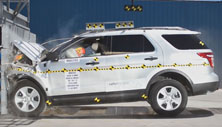
Open safety recalls, the components owners report failing most often, crash-test results and running costs for the 2019 Ford Explorer, assembled from NHTSA and EPA records.
One specific car
Checking one Ford Explorer?
Everything on this page applies to the model as a whole. Run its VIN to decode that exact car, its engine, trim, assembly plant and factory equipment, alongside these records.
Recalls and complaints are filed against a specific model year, so figures differ from one year to the next even within a single generation. See every Ford Explorer year.
NHTSA Recalls
Safety recalls
6 open
NHTSA lists 6 recalls for this make, model and year. Recalls apply to the model, so some may already be fixed on this specific car. A dealer can confirm from the VIN.
STRUCTURE:BODY05/05/2021
Issue: Ford Motor Company (Ford) is recalling certain 2016-2019 Explorer vehicles. The retention pins could loosen and allow the roof rail covers to detach from the vehicle.
Risk: A detached roof rail cover can create a road hazard, increasing the risk of a crash.
Remedy: Dealers will install push-pins and replace any damaged rail clips and roof rail covers, as necessary, free of charge. The interim owner notification letter was mailed on June 22, 2021. Owner notification letters (remedy available) were mailed on October 1, 2021. Owners may contact Ford customer service at 1-866-436-7332. Ford's number for this recall is 21S22.
Campaign 21V316000
SEATS:FRONT ASSEMBLY:RECLINER28/08/2019
Issue: Ford Motor Company (Ford) is recalling certain 2018-2020 F-150 and 2019-2020 F-250, F-350, F-450, and F-550 Super Duty pickup trucks, and 2018-2019 Ford Explorer, 2019-2020 Expedition, and 2020 Escape vehicles equipped with driver and/or passenger's manual front seat back recliner mechanisms. Also included are certain 2020 Ford Explorer and Lincoln Aviator vehicles equipped with rear outboard seats and manual seat back recliner mechanisms. The recliner mechanisms may be missing the third pawl required for seat back strength, resulting in a loose seat back. As such, these vehicles fail to comply with the requirements of Federal Motor Vehicle Safety Standard (FMVSS) numbers 202, "Head Restraints" and 207, "Seating Systems."
Risk: A seat back with an improperly assembled recliner mechanism may have reduced strength and may not adequately restrain an occupant in a crash, increasing the risk of injury.
Remedy: Ford will notify owners, and Ford and Lincoln dealers will inspect the seat structure and replace them, as necessary, free of charge. The recall began October 21, 2019. Owners may contact Ford customer service at 1-866-436-7332. Ford's number for this recall is 19C07.
Campaign 19V633000
STRUCTURE:BODY:ROOF AND PILLARS19/01/2024
Issue: Ford Motor Company (Ford) is recalling certain 2011-2019 Explorer vehicles. The A-pillar trim retention clips may not be properly engaged, allowing the trim to detach.
Risk: A detached trim piece can fall off the vehicle, becoming a road hazard and increasing the risk of a crash.
Remedy: Dealers will inspect and replace the A-pillar trim as necessary, free of charge. This will be a phased campaign, with the remedy becoming available in different phases based on model years. Owner notification letters were mailed between July 18, 2024 and December 16, 2025. Owners may contact Ford customer service at 1-866-436-7332. Ford's number for this recall is 24S02.
Issue: Ford Motor Company (Ford) is recalling certain 2016-2018 Focus, 2019 Explorer, and 2024 Explorer vehicles. The engine block heater may crack and develop a coolant leak, causing it to short circuit when the block heater is plugged in.
Risk: An electrical short circuit can increase the risk of a fire.
Remedy: Owners are advised not to plug in their block heater until the vehicle is remedied. Dealers will replace the block heater, free of charge. Owners will also have a alternative option to replace engine block heater element with a threaded blanking plug, and remove the block heater electrical cord. Interim letters, notifying owners of the safety risk, were mailed February 13, 2026. Additional letters will be sent once the final remedy is available, anticipated in October 2026. Owners may contact Ford customer service at 1-866-436-7332. Ford's number for this recall is 25SA4. Vehicle Identification Numbers (VINs) involved in this recall became searchable on NHTSA.gov on January 16, 2026. This recall expands previous recall number 25V685.
Campaign 26V012000
SUSPENSION:REAR20/02/2026
Issue: Ford Motor Company (Ford) is recalling certain 2017-2019 Explorer vehicles. The rear suspension toe links may fracture.
Risk: A rear toe link fracture can result in a loss of steering control, increasing the risk of a crash.
Remedy: Dealers will replace the toe links, free of charge. Owner notification letters were mailed on March 16, 2026. Owners may contact Ford Customer Service at 1-866-436-7332. Ford's number for this recall is 26S08. This recall is an expansion of previous NHTSA recall number 21V537. Vehicle Identification Numbers (VINs) involved in this recall will be searchable on NHTSA.gov beginning February 25, 2026.
Campaign 26V101000
STRUCTURE:BODY14/07/2026
Issue: Ford Motor Company (Ford) is recalling certain 2016-2019 Explorer vehicles. The roof rail covers may come loose and detach from the vehicle.
Risk: A detached roof rail cover can create a road hazard, increasing the risk of a crash.
Remedy: Dealers will inspect the roof rail covers and as necessary, repair or replace the push-pins, rail clips, or roof rail covers, free of charge. Interim letters, notifying owners of the safety risk, were mailed August 28, 2026. Additional letters will be sent once the remedy is available, anticipated in January 2027. Owners may contact Ford customer service at 1-866-436-7332. Ford's number for this recall is 26S54. This recall expands previous NHTSA recall number 21V316. Vehicle Identification Numbers (VINs) involved in this recall became searchable on NHTSA.gov on July 16, 2026.
The contact owns a 2019 Ford Explorer. The contact stated that while the vehicle was parked, the message "Right Rear Door Ajar" was displayed. The contact moved the rear passenger’s side door latch several times and was able to fix the failure. However, the failure recurred. The contact was concerned that the failure would drain the battery.
STRUCTURE09/04/2026
The contact owns a 2019 Ford Explorer. The contact received notification of NHTSA Campaign Number: 24V031000 (Structure); however, the part to do the recall repair was not yet available. The contact stated that while driving at an undisclosed speed, the front A-pillar trims detached. The contact was able to replace both A-pillar trims; however, the failure reoccurred. The local dealer was contacted. The manufacturer was made aware of the failure. The failure mileage was approximately 50,000.
ENGINE09/03/2026
The internal timing-chain-driven water pump on my 2019 Ford Explorer Sport 3.5L EcoBoost is failing. I began experiencing coolant loss and the cabin heat would turn cold while the vehicle was stopped or idling. The vehicle was professionally inspected by an independent repair facility. After diagnostic testing, the mechanic confirmed coolant leaking from the water pump weep hole and diagnosed a failing internal water pump. The water pump is located inside the engine and is driven by the timing chain. Continued failure can result in significant coolant loss, overheating, coolant entering the engine oil, and potentially severe engine damage or engine failure while driving. I am concerned about the safety risk of an unexpected loss of engine operation. The vehicle did not initially display an overheating warning despite the coolant loss and heating symptoms. The failure has been confirmed by a professional mechanic and documentation/photos of the leak and diagnosis are available upon request. Replacement requires extensive engine/timing-system disassembly and I was quoted several thousand dollars for the repair. I am requesting that NHTSA investigate internal water pump failures involving the 3.5L engine used in these Ford Explorer vehicles.
VEHICLE SPEED CONTROL,UNKNOWN OR OTHER,BACK OVER PREVENTION08/22/2026
I was driving down the road when the warning lights suddenly came on, and the vehicle would not allow me to accelerate. As a result, my vehicle slowed unexpectedly, and another vehicle nearly struck me from behind.
POWER TRAIN08/13/2026
In November 2025 vehicle began experiencing intermittent instances of rough shifting when the engine was under strain due to mountain driving. Since we do not live in the mountains, we returned home and waited to see if it would replicate. Vehicle began intermittently, replicating, hard shifting when coming out of Park. At that time an appointment was made with a local transmission shop in June 2026 to have an evaluation done. No error codes have been thrown at any point in time but the shop was able to highlight that there are metal flakes in the transmission fluid indicating the beginnings of mechanical malfunction of the transmission prior to 150,000 miles. At the time this started the vehicle was at approximately 137,000 miles. It is now at approximately 154,000 approximately one year later. It is my daily driver and only motive transportation. Shop has recommend a transmission rebuild due to metal flakes in the engine. It is a well-known fact, two Ford that they installed faulty, transmissions that prematurely go out however, they have not completed a recall to this date still. This puts unnecessary financial hardship on the consumer when the vehicle starts to fail prematurely.
SUSPENSION08/12/2026
Both the rear toe links were replaced under NHTSA # 26V101 on March 26th, 2026. On August 8th, 2026, the vehicle experience significant handling issues at highway speeds. Was found the toe links shifted post recall. Significant cambered tire wear located on both rear tires. The axel shaft seal developed a leak from the suspension system strain caused from toe links failing. My families safety was at risk due to the tires and suspension failing causing significant handling issues at highway speeds. The vehicle was parked immediately after inspecting the rear end. Approximately 4,500 miles driven since recall service. Vehicle is now back with FORD dealership as of August 11th, 2026 for inspection. FORD dealership is expected to invoice repair costs for failed axel shaft seal. FORD is covering the rear tire replacement along with re-alignment. No warning lamps or messages observed.
STRUCTURE08/11/2026
The contact owns a 2019 Ford Explorer. The contact stated that the vehicle was taken to the dealer to be repaired under NHTSA Campaign Number: 24V031000 (Structure); however, the recall repair was not performed because the A-pillar trim had not completely detached. While driving the vehicle at an undisclosed speed, the A-pillar trim detached. The dealer was contacted after the trim had fully detached, but recall repair was not performed. The contact stated that the dealer cleared the recall from the VIN and refused to perform any repairs associated with the recall. The manufacturer was made aware of the failure and referred the contact to the NHTSA Hotline to report the failure. The failure mileage was approximately 90,000.
STRUCTURE07/22/2026
Passenger side exterior B pillar trim came off while driving on highway on July 3, 2026. Trim was on vehicle when it left home. It was not on it when it arrived at destination. Possible danger to other drivers from flying trim component. No inspection or any symptoms of the problem prior to failure. Same problem as recall on 2016-2017 models.
STRUCTURE07/16/2026
The contact owns a 2019 Ford Explorer. The contact received notification of NHTSA Campaign Number: 24V031000 (Structure); however, the part to do the recall repair was not yet available. The contact stated that the manufacturer had exceeded a reasonable amount of time for the recall repair. The contact stated that the exterior A-pillar trim had detached from the vehicle. The dealer was made aware of the failure but confirmed that parts were not yet available. The vehicle was not repaired. The manufacturer was not made aware of the failure. The failure mileage was approximately 44,000.
STRUCTURE07/15/2026
Component/System: Aluminum hood panel (front edge seam). The hood is available for inspection upon request. The front edge of the aluminum hood on my 2019 Ford Explorer has developed bubbling, lifting paint, and corrosion originating from inside the folded seam. The defect has progressively worsened over time and continues to spread outward. Safety Risk: The corrosion is occurring at the front hood seam, which is part of the structure that supports the hood latch area. Progressive corrosion in this region may weaken the hood panel over time, potentially affecting hood retention at highway speeds. Paint loss and metal degradation also reduce visibility of the defect until it becomes severe. Reproduction/Confirmation: The problem is visible and reproducible at any time. The bubbling and corrosion are present continuously and worsen with normal vehicle use. Inspection History: The issue has been visually inspected by me. The vehicle has not yet been inspected by the manufacturer, dealer, police, or insurance representatives. Warning Lamps or Messages: No warning lamps or messages appeared. There were no electronic symptoms prior to the failure. The first visible symptom was small paint bubbles along the front hood edge, which appeared approximately when the corrosion began. Assessment: Based on widespread reports for this model year and Ford’s own Technical Service Bulletins for aluminum panel corrosion, the cause appears to be corrosion originating inside the aluminum hood seam, likely due to manufacturing contamination.
STRUCTURE07/14/2026
The contact owns a 2019 Ford Explorer. The contact stated that the leather on the dashboard was peeling and had detached. No warning lights were illuminated. The local dealer was contacted, but the vehicle was not diagnosed or repaired. The manufacturer was not notified of the failure. The failure mileage was approximately 100,000.
STEERING,SUSPENSION07/14/2026
The contact owns a 2019 Ford Explorer. The contact stated that while driving 80 MPH, the steering wheel was abnormally loose, and the vehicle became uncontrollable. The contact stated that the brake pedal was depressed; however, the vehicle failed to stop as intended. The vehicle was driven to the shoulder of the road, and the brake pedal was depressed to the floorboard. The brake pedal was depressed several times, and the vehicle stopped. No warning lights were illuminated. A driver nearby assisted with stopping traffic to allow the contact to drive the vehicle off to the shoulder of the roadway. The vehicle was inspected, and the other driver became aware that the rear tires were completely bald. The vehicle was taken to Discount Tires, and the contact was informed that the failure was because of the rear suspension. The contact was advised to take the vehicle to the dealer. The vehicle was taken to the dealer and was informed that the vehicle was previously repaired under NHTSA Campaign Number: 26V101000 (Suspension) in March 24, 2026. In addition, the contact was informed that an alignment was not performed because the alignment machine was unavailable. The contact had not been informed that the recall repair was completed. The dealer informed the contact that an alignment had been completed. The vehicle was repaired. The manufacturer was not made aware of the failure. The failure mileage was approximately 147,419.