Open safety recalls, the components owners report failing most often, crash-test results and running costs for the 2016 Nissan Sentra, assembled from NHTSA and EPA records.
Everything on this page applies to the model as a whole. Run its VIN to decode that exact car, its engine, trim, assembly plant and factory equipment, alongside these records.
Open a VIN recordRecalls and complaints are filed against a specific model year, so figures differ from one year to the next even within a single generation. See every Nissan Sentra year.
32.8 mpg average · 28–38 range · EPA says 32
Over 5 years this costs $1,500 less in fuel than an average new vehicle.
NHTSA lists 6 recalls for this make, model and year. Recalls apply to the model, so some may already be fixed on this specific car. A dealer can confirm from the VIN.
Issue: Nissan North America, Inc. (Nissan) is recalling certain 2015-2017 LEAF and 2014, 2016 and 2017 Sentra vehicles. Due to a manufacturing error within the air bag inflators, the passenger frontal air bag may not properly deploy in the event of a crash.
Risk: In the event of a crash, if the front passenger air bag doesn't deploy properly, it can increase the risk of injury to passengers.
Remedy: Nissan will notify owners, and dealers will replace the front passenger air bag inflator, free of charge. The recall began June 7, 2017. Owners may contact Nissan customer service at 1-800-647-7261.
Campaign 17V253000
Issue: Nissan North America, Inc. (Nissan) is recalling certain model year 2016 LEAF vehicles manufactured February 24, 2016, to March 23, 2016, and Sentra vehicles manufactured February 9, 2016, to March 4, 2016. The wiring harness connector may disconnect from the dual-stage passenger air bag.
Risk: If the wiring harness disconnects, the passenger air bag may not to deploy during a crash, increasing the risk of injury.
Remedy: Nissan will notify owners, and dealers will inspect the wiring harness connector for proper engagement and, if necessary, replace the passenger air bag module and main body harness, free of charge. The recall began on August 9, 2016. Owners may contact Nissan customer service at 1-800-647-7261.
Campaign 16V436000
Issue: Nissan North America, Inc. (Nissan) is recalling certain model year 2016 Sentra vehicles manufactured April 11, 2016, through April 26, 2016. The engine room harness may have a terminal pin too large to maintain a connection with the Engine Control Unit (ECU).
Risk: If the engine room harness loses connection to the ECU, the vehicle may not start or the engine may stall, increasing the risk of a crash.
Remedy: Nissan will notify owners, and dealers will replace the terminal pin on the engine room harness, free of charge. The recall began on August 15, 2016. Owners may contact Nissan customer service at 1-800-647-7261.
Campaign 16V485000
Issue: Nissan North America, Inc. (Nissan) is recalling certain model year 2016-2017 Nissan Maxima, 2013-2016 Nissan Altima, NV200, LEAF, Sentra, and Pathfinder, 2014-2016 Nissan NV200 Taxi, Infiniti QX60, QX60 Hybrid, and Q50 Hybrid, 2014-2017 Nissan Rogue and Infiniti Q50, 2015-2016 Nissan Murano, Murano Hybrid, and Chevrolet City Express, 2014-2015 Nissan Pathfinder Hybrid, and 2013 Infiniti JX35 vehicles. In these vehicles, the front seat passenger Occupant Classification System (OCS) may incorrectly classify an adult passenger as a child or classify the seat as empty despite it being occupied. As a result, the passenger frontal air bag may be turned off and not deploy in the event of a crash.
Risk: If the passenger frontal air bag does not deploy as intended in the event of a crash, the passenger is at an increased risk of injury.
Remedy: Nissan will notify their owners. Chevrolet City Express owners will be notified by General Motors. Dealers will reprogram the Air Bag Control Unit (ACU) and OCS Electronic Control Unit (ECU) in Altima, Maxima, Murano, Rogue, and Sentra vehicles, and replace the OCS ECU in LEAF, NV200, NV200 Taxi, Pathfinder, Infiniti Q50, JX35, and QX60 and Chevrolet City Express vehicles, free of charge. Interim notices were sent to owners on May 31, 2016. Owners will receive a second notice when remedy parts become available. Owners may contact Nissan customer service at 1-800-867-7669, Infiniti customer service at 1-888-833-3216 or Chevrolet customer service at 1-800-222-1020.
Campaign 16V244000
Issue: Nissan North America, Inc. (Nissan) is recalling certain model year 2013-2016 Sentra vehicles manufactured June 4, 2012, to April 9, 2016. The front passenger seat belt bracket may become deformed if it is used to secure a Child Restraint System (CRS). The deformed seat bracket may cause the Occupant Classification System (OCS) to incorrectly classify the installed CRS, resulting in the front passenger air bag to not be turned off as designed when a CRS is in the seat.
Risk: If the frontal passenger air bag deploys in the event of a crash when a child seat is installed in the front passenger seat, there will be an increased risk of injury to the child in the CRS.
Remedy: Nissan will notify owners, and dealers will reinforce the seat belt bracket as well as reprogram the Air Bag Control Unit (ACU) and OCS Electronic Control Unit (ECU), free of charge. The recall began on June 13, 2016. Owners are warned not to install a CRS in the front seat. Owners may contact Nissan customer service at 1-800-867-7669.
Campaign 16V242000
Issue: Nissan North America, Inc. (Nissan) is recalling certain 2016-2019 Nissan Sentra vehicles. The brake light switch may become contaminated, preventing the circuit from closing and the brake lights from illuminating.
Risk: The brake lights may not illuminate, increasing the risk of a crash.
Remedy: Dealers will replace the brake light switch and install a protective grommet, free of charge. Owner notification letters were mailed July 1, 2022. Owners may contact Nissan customer service at 1-800867-7769. Nissan's number for this recall is PM971.
Campaign 21V135000

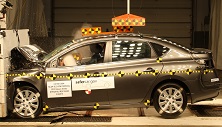
NHTSA frontal crash test
Rated configuration: 2016 Nissan Sentra 4 DR FWD
The parts named most often across 270 owner complaints filed with NHTSA for this make, model and year.
2 crashes · 1 injured
7 crashes · 4 injured
1 fire
1 fire
2 crashes · 2 injured
Complaints are self-reported and skew toward problems people find alarming, so read this as where to look rather than as a defect rate.
The ECU problem is a major issue the vehicle is stalling, not starting, just malfunctioning tremendously while on the road in traffic while driving it stalls in traffic, shuts off in traffic. I was told this was a issue back in July 2017 The same issue has occurred again with safety concerns .
The contact owns a 2016 Nissan Sentra. The contact stated that while driving at an undisclosed speed, the traction control warning light illuminated. The vehicle was taken to an AutoZone and DTC: C1116 “Stop Lamp Switch" was retrieved. The local dealer was contacted; however, the vehicle was not diagnosed. The contact was informed that the VIN was not under recall. The vehicle was not repaired. The manufacturer was not notified of the failure. The contact associated the failure with NHTSA Campaign Number: 21V135000 (EXTERIOR LIGHTING). The failure mileage was 130,000.
In 2023, my vehicle experienced a transmission/CVT-related failure that resulted in a loss of propulsion. The vehicle became unable to continue driving and was stopped in Chino Hills, California. A neighbor called the police, and officers responded to the scene, although no police report was filed. The vehicle was subsequently towed to an authorized Nissan dealership, where the transmission/transaxle was replaced. After the replacement, the vehicle later developed a transmission fluid leak. I returned the vehicle to the authorized dealership regarding the leak, and the concern was addressed at no charge. However, the transmission fluid leak has since recurred. An independent repair facility recently inspected the vehicle and observed an active fluid leak around the transmission assembly, as well as an apparent abnormal condition in the transmission area. The exact cause of the current leak has not yet been fully diagnosed and is currently unknown. The condition is available for further inspection. The Check Engine Light is currently illuminated, and the vehicle is unable to pass an emissions inspection. My primary concern is vehicle safety. This vehicle previously experienced an actual loss of propulsion associated with a transmission-related failure and had to be towed. Because the replacement transmission/transaxle is now experiencing a recurring fluid leak and an unresolved condition, I am concerned about the possibility of another transmission-related mechanical failure or loss of propulsion while driving. I am also concerned about potential safety risks associated with continued fluid leakage in the vehicle. The current problem has been observed by an independent repair facility but has not yet received a complete formal diagnosis. To my knowledge, the manufacturer has not inspected the current recurring condition.
On Friday, July 3, 2026, at approximately 9:30 PM, while driving on the parkway at an approximate speed of 65 miles per hour and preparing to merge onto the highway, the vehicle unexpectedly stalled completely. I was able to safely maneuver the vehicle to the shoulder of the road. After a few minutes, once the immediate traffic situation on the highway entrance cleared, I attempted to re-engage the vehicle. While the engine started, it immediately began revving excessively high without corresponding forward momentum. The vehicle moved at an extremely slow pace despite the high engine RPMs, indicating a severe loss of power transfer to the wheels. Current Status: The vehicle is presently parked and cannot be driven due to this ongoing issue. It remains inoperable.
Odometer Fraud. The contact purchased a 2016 Niss. The contact stated that they discovered that there was a mileage discrepancy after the purchase. The vehicle was a private sale/dealer sale. At the time of purchase, the vehicle mileage was 107,242. It was later discovered upon checking Carfax, that the mileage was 149,244.
The CVT transmission, which Nissan has had many issues with per the large number of class action lawsuits, failed while I was driving the vehicle on a main street in San Diego. The vehicle showed no indication (warning light) that there was any engine failure or issue. The CVT transmission just died unexpectedly while the vehicle was moving with traffic. I brought the vehicle to Mossy Nissan in National City and they confirmed the CVT transmission failed. The vehicle only has 87,762 miles on it. Nissan claimed they are not responsible. I only learned of the large number of CVT transmission lawsuits once this happened. They have broken their lawsuits into different vehicle years, makes, and models so to avoid listing this issue as a recall across the brand.
The vehicle stopped accelerating while driving and after stopping, would not exceed 5-10 mph. Vehicle was towed to a mechanic who advised that the transmission had failed.
The contact owns a 2016 Nissan Sentra. The contact stated that while driving at 60 MPH, the sunroof exploded and shattered without impact. The contact exited the highway, pulled over to the side of the road, and took pictures of the failure. The dealer and the manufacturer were not informed of the failure. The vehicle was not diagnosed or repaired. The failure mileage was approximately 142,000.
The CVT transmission went out when I was driving on an interstate. I was driving 65 mph and within seconds my speed dropped with a tractor trailer behind me. I thankfully was able to pull off to the side of the road, but almost crashed in the process. The check engine light also did not come on until 17 minutes after the transmission failed. An independent service center confirmed the problem and stated that they’ve seen many other Sentra’s with the same problem. The vehicle has not been inspected by the manufacturer, police, insurance representatives, etc. Very dangerous situation with no warning signs.
Odometer Fraud. The contact purchased a 2016 Nissan Sentra. The contact discovered a mileage discrepancy after the purchase. The vehicle was a dealer sale. At the time of purchase, the vehicle mileage was approximately 93,000. It was later discovered that the title mileage was 119,200. The contact called the dealer and requested the odometer be updated. The contact took the vehicle to the dealer. The dealer called the contact to pick up the vehicle, that the vehicle would not be repaired, and that the vehicle had too many failures.
Ive took my car to alhambra dealer for a recall and before I did i scared my car with the obd2 to make sure everything was okay witch it scanned no check engine and all green check lights IM REDINESS.. AFTER I PICKED UP MY CAR FROM THE DEALER I TOOK THE CAR HOME AND PARKED IT FOR A WHOLE DAY. THE NEXT DAY MY CAR STARTS THROWING CODES AND NOW MY CAR WONT PASS SMOG BECAUSE THEE DEALER RUINNED MY CAR.
The contact owns a 2016 Nissan Sentra. The contact stated that while driving at an undisclosed speed, the vehicle erratically jerked and the vehicle stalled. The contact noticed an abnormal whining sound. No warning light was illuminated. The vehicle was taken to the dealer, where it was diagnosed with transmission failure. The contact was informed that the transmission needed to be replaced. The vehicle was not repaired. The contact stated that days later, while attempting to start the vehicle, the gear shifter was shifted into reverse and the engine seized. The contact stated that the vehicle was inoperable. The manufacturer was made aware of the failure but provided no assistance. The contact was informed that the repair was not covered under warranty. The failure mileage was approximately 163,000.
Showing 12 of 270 complaints.