Open safety recalls, the components owners report failing most often, crash-test results and running costs for the 2026 Subaru Ascent — assembled from NHTSA and EPA records.
Everything on this page applies to the model as a whole. Run its 17-character VIN to decode that exact car — its engine, trim, assembly plant and factory equipment — alongside these records. Free, no account.
Run a VIN →Recalls and complaints are filed against a specific model year, so figures differ from one year to the next even within a single generation. See every Subaru Ascent year.
NHTSA lists 1 recall for this make/model/year. Recalls apply to the model, so some may already be fixed on this specific car — check with a dealer using the VIN.
Issue: Subaru of America, Inc. (Subaru) is recalling certain 2026 Crosstrek Hybrid, 2025-2026 Forester Hybrid, Forester, and 2019-2026 Ascent vehicles. These vehicles were manufactured with an incorrect Gross Axle Weight Rating (GAWR) on the certification label. As such, these vehicles fail to comply with the requirements of Federal Motor Vehicle Safety Standard (FMVSS) 110, "Tire selection and rims."
Risk: An incorrect GAWR label may lead to an overloaded vehicle, increasing the risk of a crash.
Remedy: Subaru will mail a new certification label to owners, free of charge. Owners may also choose to have a dealer install the new label, free of charge. Letters informing owners of the safety risk are expected to be mailed August 25, 2026. Additional letters will be mailed once the remedy is available. Owners may contact Subaru customer service at 1-844-373-6614. Subaru's number for this recall is WRH-26.
Campaign 26V436000
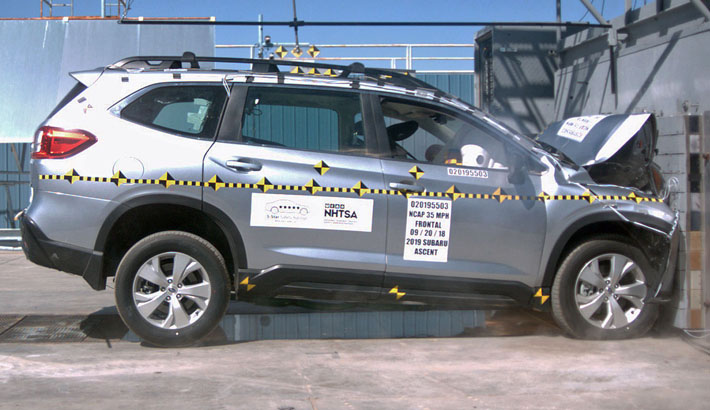
NHTSA frontal crash test
Rated configuration: 2026 SUBARU ASCENT SUV N/A AWD
The parts named most often across 1 owner complaintfiled with NHTSA for this make, model and year — the closest free answer to “what is likely to go wrong?”
Complaints are self-reported and skew toward problems people find alarming, so treat this as where to look, not a defect rate.
The contact owns a 2026 Subaru Accent. The contact stated that there was a failure related to the brake pedal design. The contact stated that there was an approximate one-inch difference in spacing between the brake pedal and the accelerator pedal in previous model vehicles. The contact stated that there was an approximate four-inch gap between the brake and accelerator pedals, while previous models had an approximate three-inch space. The contact stated that the difference created a hazardous driving condition and increased the risk of unintended pedal application. Additionally, there were several instances where a crash could have occurred due to the pedal spacing. The vehicle was taken to the dealer; however, it was not diagnosed or repaired. The dealer informed the contact that several complaints were received with the same issue and referred the contact to the NHTSA Hotline to report the failure. The manufacturer was not made aware of the failure. The approximate failure mileage was 1,040.
Over 5 years this costs $3,000 more in fuel than an average new vehicle.